Mycin vs micin: one letter, two organisms
The endings mark the organism that produced the antibiotic, not how it works. Why gentamicin and erythromycin are spelled differently and share nothing else.
Photo: Microrao / CC BY-SA 4.0, via Wikimedia CommonsShort answer: bactericidal antibiotics kill bacteria and bacteriostatic antibiotics stop them replicating. The distinction is a laboratory measurement rather than a property of the drug, it shifts with test conditions and organism, and in severe infection trials the two groups perform comparably. Exams still test the binary, so learn it, and learn why it is softer than it looks.
Bactericidal means the agent kills the organism, while bacteriostatic means it suppresses replication and leaves killing to the host. That difference matters in principle because a bacteriostatic drug depends on a working immune system to clear the organism it has paused. The distinction is therefore a claim about who finishes the job rather than about how hard the drug works. Both definitions describe an outcome in a test tube, not a fixed chemical property of the molecule. That is the fact everything else in this post follows from.
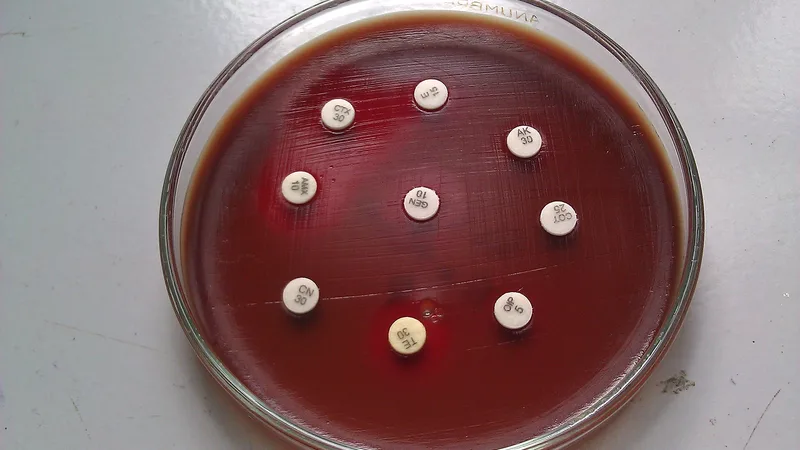
The minimum inhibitory concentration is the lowest concentration of an antimicrobial that prevents visible growth of an organism after overnight incubation [1]. It is measured by methods such as broth dilution or disk diffusion, and it is reported as a number that looks far more absolute than it is [1]. The MIC depends on the interaction between drug, organism and test conditions, which include media pH and ion concentration, incubation temperature and atmosphere, inoculum size and incubation duration [1]. Change the conditions and you change the number, which is why an MIC is a measurement rather than a constant.
The minimum bactericidal concentration is the lowest concentration that kills the organism rather than merely inhibiting it. The conventional definition of a bactericidal agent is an MBC no more than four times its MIC, so the classification rests on a ratio between two laboratory numbers [2]. A drug whose MBC sits far above its MIC is called bacteriostatic by the same arithmetic. The bactericidal label is therefore assigned by a threshold on a ratio, not observed directly as killing in a patient. Once you see that, the exceptions stop being surprising.
MBC divided by MIC, with a cutoff of four. Two laboratory numbers and one arbitrary threshold decide whether a drug is called bactericidal.
The ratio inherits every weakness of the two numbers that make it. A 2024 review in the Journal of Antimicrobial Chemotherapy notes that the MBC/MIC definition is laboratory-based, that the techniques used to calculate the ratio differ between laboratories, and that some studies have used non-standardised methods [2]. Two laboratories can therefore classify the same drug differently without either being wrong. A classification that is not reproducible across laboratories cannot be a stable property of the molecule, which is the first reason to hold the binary loosely.
The second reason is what the test leaves out. The same review points out that these tests do not necessarily mimic in vivo conditions and do not account for the host immune system or its interaction with bacteria and antibacterial agents [2]. A bacteriostatic drug in a patient is working alongside neutrophils and complement, none of which exist in a broth tube. The distinction matters most exactly where the test measures least, which is in a host that can finish the job. The authors conclude that predicting how an agent will behave in a real infected patient is likely to be highly challenging [2].
Mechanism explains the lists better than the lists explain themselves. Beta-lactams and glycopeptides block peptidoglycan cross-linking, so the growing cell builds a defective wall. That wall cannot contain the organism's internal osmotic pressure, and the cell lyses. Killing follows because the damage is structural and the cell cannot survive it even if the drug is removed. Fluoroquinolones reach the same endpoint differently by trapping DNA gyrase and topoisomerase IV, which produces double-strand DNA breaks the organism cannot repair.
Macrolides, tetracyclines and clindamycin bind the ribosome reversibly, so translation stalls while the drug is present. The bacterium is not structurally damaged, and removing the drug lets protein synthesis resume. Reversible binding to a functional target inhibits, while irreversible damage to a structural one kills, and that is the whole pattern. Folate antagonists sit in the same logic, since depleting a precursor halts replication without breaking anything. Recognising the class from the drug name speeds this up, which is what drug name stems are for.
Aminoglycosides break the pattern and are the exception examiners love. They inhibit protein synthesis at the 30S subunit, which should make them bacteriostatic by the logic above, yet they are firmly bactericidal. They bind irreversibly, and the mistranslated proteins they generate are inserted into the cell membrane, where they compromise membrane integrity. The killing comes from membrane damage downstream of the ribosome, not from the ribosomal block itself. Their narrow therapeutic window is covered in aminoglycoside monitoring.
Several agents change category depending on the organism, which is difficult to reconcile with a fixed property. Linezolid is generally bacteriostatic but behaves bactericidally against some streptococci. Chloramphenicol is usually bacteriostatic yet is described as bactericidal against certain respiratory pathogens. A drug that is cidal against one organism and static against another is telling you the label belongs to the drug-organism pair, not to the drug. This is the cleanest evidence that the binary is a simplification.
| Class | Target | Conventional label | Why |
|---|---|---|---|
| Beta-lactams (penicillins, cephalosporins) | Cell wall synthesis | Bactericidal | Wall fails under osmotic pressure, so the cell lyses |
| Glycopeptides (vancomycin) | Cell wall synthesis | Bactericidal | Blocks peptidoglycan cross-linking precursor |
| Aminoglycosides | Protein synthesis (30S) | Bactericidal | Irreversible binding plus membrane damage from misread proteins |
| Fluoroquinolones | DNA gyrase / topoisomerase IV | Bactericidal | Double-strand DNA breaks |
| Macrolides | Protein synthesis (50S) | Bacteriostatic | Reversible binding stalls elongation |
| Tetracyclines | Protein synthesis (30S) | Bacteriostatic | Reversible block of tRNA docking |
| Clindamycin | Protein synthesis (50S) | Bacteriostatic | Reversible binding stalls elongation |
| Sulfonamides / trimethoprim | Folate synthesis | Bacteriostatic | Depletes precursors rather than damaging structure |
| Linezolid | Protein synthesis (50S) | Bacteriostatic (context dependent) | Bactericidal against some streptococci |
Antimicrobial mechanisms, one drug at a time, on the PharmBit app. Five minutes a day.
If the distinction drove outcomes, bactericidal agents should outperform bacteriostatic ones in serious infection. Studies comparing bacteriostatic with bactericidal antibacterials in the management of severe infections found no significant difference in clinical cure, mortality or relapse rates [2]. The classification that dominates teaching does not separate outcomes in the situations where it should matter most. The review's overall conclusion is that the conventional in vitro classification lacks clarity in the clinical setting [2].
Exams test the binary because it remains a compact way to check whether you understand antibiotic mechanism. Knowing that beta-lactams kill and macrolides inhibit is shorthand for knowing what each one targets. The classification also still informs some real decisions, such as concern about relying on a bacteriostatic agent in a profoundly immunocompromised patient. Answer the classification the examiner expects, while understanding it as a laboratory convention rather than a law of nature. Both are required, and they are not in conflict.
A stem asking which agent is bactericidal is testing the mechanism lists, so answer from the target. A stem pairing an aminoglycoside with protein synthesis inhibition is testing the exception. A stem describing an immunocompromised patient is testing whether you understand that bacteriostatic agents lean on host defences. Each question type maps onto a different layer of the same idea, which is why the mechanism is more useful than the list. Those layers recur across NAPLEX, PEBC, GPhC CRA, OPRA and PCN papers.
Bactericidal and bacteriostatic describe an MBC to MIC ratio measured in a laboratory, with a conventional cutoff of four. Both underlying numbers move with test conditions, the techniques differ between laboratories, and the tests exclude the host immune system entirely. Mechanism explains the lists, since structural damage to the wall or DNA kills while reversible ribosomal binding only pauses growth, with aminoglycosides killing through membrane damage instead. In severe infection the two groups have not separated on cure, mortality or relapse, so the binary is best held as an exam convention rather than a clinical rule.
1. Why are aminoglycosides bactericidal despite inhibiting protein synthesis at the 30S subunit?
2. A drug has an MIC of 2 mg/L and an MBC of 4 mg/L. By the conventional definition, how is it classified?
3. What is the strongest argument that the bactericidal/bacteriostatic binary is a simplification?
Bactericidal agents kill bacteria and bacteriostatic agents inhibit their replication. The distinction is defined in the laboratory by the ratio of the minimum bactericidal concentration to the minimum inhibitory concentration, conventionally with a ratio of four or less counting as bactericidal.
Less than teaching implies. A 2024 review in the Journal of Antimicrobial Chemotherapy concluded the conventional in vitro classification lacks clarity in the clinical setting, and trials comparing the two groups in severe infection found no significant difference in clinical cure, mortality or relapse.
Most protein synthesis inhibitors bind reversibly and only stall growth, so bacteria recover when the drug is removed. Aminoglycosides bind irreversibly and cause mistranslated proteins to be inserted into the membrane, which damages membrane integrity and kills the cell.
The minimum inhibitory concentration is the lowest concentration of an antimicrobial that prevents visible growth of an organism after overnight incubation. It is a laboratory measurement and shifts with pH, media ion content, temperature, atmosphere, inoculum size and incubation time.
Yes. Exams continue to test the classification even though the literature questions its clinical weight. Learn the lists, learn the mechanism that generates them, and learn the caveats so you can answer the question asked without believing the binary is absolute.
For study only. This post explains pharmacology concepts for exam preparation. It is not medical advice. Always follow your course materials, formulary, and supervisor guidance for clinical decisions.
Understanding why beats memorizing what. One mechanism explained properly, every day.
Free to download. 7-day Pro trial. No credit card.
The endings mark the organism that produced the antibiotic, not how it works. Why gentamicin and erythromycin are spelled differently and share nothing else.

Which receptors each class blocks, why selectivity fades as the dose rises, and the asthma trap. Mechanism-first in seven minutes.

Codeine is a prodrug activated by CYP2D6, morphine is not. Poor and ultra-rapid metabolisers, and the exam trap.

Bradykinin cough, angioedema rules and pregnancy contraindications compared. The exam-trap pair in six minutes.