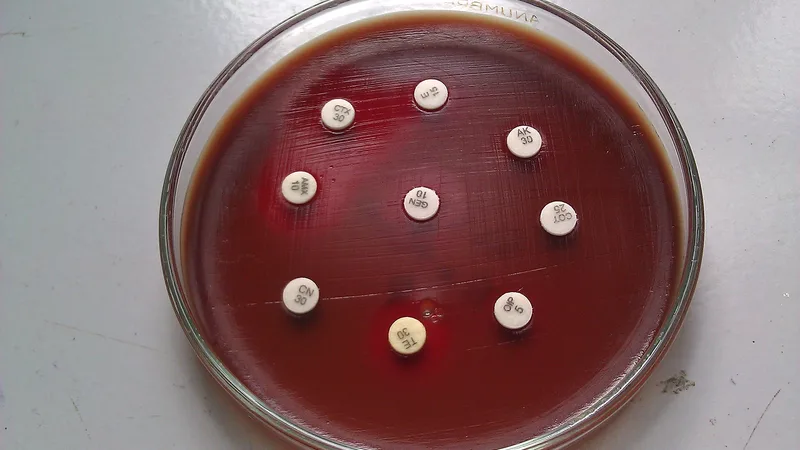
Mycin vs micin: one letter, two organisms
The endings mark the organism that produced the antibiotic, not how it works. Why gentamicin and erythromycin are spelled differently and share nothing else.
 Photo: NIH BioArt / Public domain, via Wikimedia Commons
Short answer: codeine is a prodrug. CYP2D6 converts it to morphine, and morphine produces the analgesic effect. Morphine itself requires no activation.
A prodrug is a compound with minimal pharmacological activity that requires metabolic conversion to an active metabolite, and that dependency makes the converting enzyme the true decision-maker for the drug. Codeine has low affinity for opioid receptors, so without conversion it cannot relieve pain. Hepatic CYP2D6 O-demethylates codeine to morphine, and morphine then binds mu-opioid receptors directly with no further conversion step. The clinical consequence follows immediately: codeine efficacy equals CYP2D6 activity, while morphine efficacy is independent of it.
CYP2D6 activity varies across the population because the gene is highly polymorphic, with poor, intermediate, extensive and ultra-rapid phenotypes. Poor metabolisers convert almost no codeine to morphine, so standard doses produce inadequate analgesia and dose escalation cannot fix the deficit. Ultra-rapid metabolisers convert codeine rapidly, producing high morphine plasma concentrations from standard doses, with risk of opioid toxicity including respiratory depression. The Clinical Pharmacogenetics Implementation Consortium guideline for codeine and CYP2D6 classifies these phenotypes and their prescribing implications.
Codeine needs CYP2D6 to become morphine. Morphine is already morphine. Enzyme activity determines codeine response and does not affect morphine response.
In CYP2D6 poor metabolisers, codeine is ineffective and an alternative analgesic is indicated, because no dose adjustment overcomes absent conversion. In ultra-rapid metabolisers, codeine carries toxicity risk at standard doses, because rapid conversion overshoots morphine exposure. Morphine response is independent of CYP2D6 status in both phenotypes, which makes it the predictable alternative. Regulatory agencies contraindicate codeine in children after tonsillectomy or adenoidectomy following reports of fatal respiratory depression in ultra-rapid metabolisers.
Children carry disproportionate risk because ultra-rapid metabolism combines with smaller body mass and developing respiratory control. Post-tonsillectomy pain already compromises the airway through swelling and bleeding risk, so superimposed opioid-induced respiratory depression becomes life-threatening faster than in adults. Regulatory contraindications therefore target exactly this intersection: codeine after tonsillectomy or adenoidectomy in children. Exam stems that combine a child, a tonsillectomy and codeine test recognition of this absolute contraindication, not dose calculation.
Prodrug traps like this are drilled daily inside the PharmBit app, one mechanism, one trap, five minutes.
CYP2D6 inhibitors, including fluoxetine and paroxetine, reduce codeine activation and blunt its effect. This is the same enzyme family behind other high-yield interactions. See why grapefruit blocks statins for the CYP3A4 equivalent. Tramadol shares the prodrug property: CYP2D6 converts it to O-desmethyltramadol, per the StatPearls review of tramadol pharmacology.
Codeine is a weaker form of morphine. It is not a form of morphine at all until CYP2D6 acts on it. The distinction determines every exam answer on this pair.
If phenotype decides whether codeine works, the obvious question is why it is not tested before prescribing. Pharmacogenomic testing for CYP2D6 exists and is used in some settings, but it is not routine in most systems, and codeine is frequently prescribed in urgent or community contexts where no result would be available in time. The practical result is that prescribers work blind and discover the phenotype from the patient's response. Codeine is effectively an unblinded trial of the patient's own enzyme activity, run one dose at a time. That reality is what makes the class-level argument persuasive: choosing a drug whose effect does not depend on an unknown enzyme removes the uncertainty rather than testing for it. It also explains why prescribing guidance has shifted against codeine in several settings, since a drug with unpredictable activation is difficult to use safely at population scale even when it performs acceptably for most individuals.
CYP2D6 is unusual among drug-metabolising enzymes because its gene is highly polymorphic, and the variation is not a simple on-off switch. Individuals are grouped as poor, intermediate, normal or ultra-rapid metabolisers, and the grouping depends both on which variant alleles are present and on how many functional copies of the gene a person carries. Gene duplication is the mechanism behind the ultra-rapid phenotype, since extra functional copies produce more enzyme than the reference genotype. CYP2D6 activity varies across a continuum produced by allele function and gene copy number, which is why the clinical consequence ranges from no analgesia to dangerous overdose. The frequency of each phenotype also differs substantially between populations, so assumptions drawn from one group do not transfer to another. Poor metabolisers are relatively common in European-ancestry populations, while ultra-rapid metabolism is reported more frequently in some North African and Middle Eastern populations, so a drug that performs predictably in one setting can behave differently in another. This is one of the few places in pharmacology where population genetics changes prescribing practice directly rather than theoretically, and it is a reason exam boards in different countries weight the topic differently.
The prodrug relationship converts enzyme variation directly into clinical outcome, and it does so in both directions. A poor metaboliser converts very little codeine to morphine, so the patient reports that the drug simply does not work and may be wrongly suspected of drug-seeking when they ask for something stronger. An ultra-rapid metaboliser converts far more than expected, producing morphine concentrations out of proportion to the codeine dose given, with sedation and respiratory depression following. The same prescription produces treatment failure in one patient and opioid toxicity in another, purely because the enzyme that activates the drug differs between them. Morphine bypasses the problem entirely, because it arrives already active and needs no conversion step.
Codeine is the classic example but not the only one, and exams increasingly use tramadol instead. Tramadol also depends on CYP2D6 to generate its active metabolite, so the same phenotype effects apply to its opioid component. Tramadol is more complicated overall because it additionally inhibits serotonin and noradrenaline reuptake, and those actions do not depend on CYP2D6 at all. A poor metaboliser on tramadol loses the opioid effect while keeping the monoamine effects, which is why analgesia fails but serotonergic interaction risk remains. That residual serotonergic activity is why tramadol appears in serotonin syndrome stems alongside antidepressants, and why the risk does not disappear simply because the patient reports the drug is not helping their pain. Tramadol also lowers the seizure threshold independently of its opioid action, so the two non-opioid properties both persist regardless of CYP2D6 status. Recognising that split is what separates a superficial answer from a correct one when tramadol appears in a stem.
Genotype is fixed but enzyme activity is not, because inhibition can convert a normal metaboliser into a functional poor metaboliser. Fluoxetine, paroxetine and bupropion are potent CYP2D6 inhibitors, and all three are commonly co-prescribed with analgesics in exactly the patient groups who need them. The resulting phenocopy is indistinguishable from inherited poor metaboliser status while the inhibitor is present, and it reverses once the inhibitor is withdrawn and enzyme activity recovers. A drug interaction can produce the same failure as a genetic variant, and it is far more common than the variant itself. The general rules governing when this happens, and why prodrugs reverse the usual direction of interaction, are set out in CYP450 inducers and inhibitors.
The practical consequence is that some opioids sidestep CYP2D6 and some do not, which is the basis for substitution. Morphine and hydromorphone are active as administered and do not rely on CYP2D6 activation, so their effect does not vary with phenotype in the same way. Codeine and tramadol both depend on it, and oxycodone occupies a middle position because CYP2D6 produces an active metabolite while the parent drug retains activity of its own. When phenotype is unknown and reliability matters, an opioid that arrives active removes the variable rather than managing it. Equivalence tables between opioids are therefore less reliable for codeine and tramadol than they look, because any stated conversion assumes an average rate of activation that a given patient may not have. A poor metaboliser converted from codeine onto an equivalent morphine dose can receive considerably more opioid effect than they were previously getting, since they were never receiving the full nominal equivalent in the first place. That is a genuine clinical trap rather than an exam artefact, and it follows directly from the prodrug relationship. The wider class comparison sits in our opioid class guide.
Codeine failure in a poor metaboliser indicates an alternative analgesic, not a higher codeine dose. Codeine toxicity at a standard dose indicates ultra-rapid metabolism. Morphine is unaffected in both phenotypes.
Codeine requires CYP2D6 conversion to morphine, so enzyme activity determines its effect: poor metabolisers get no analgesia, ultra-rapid metabolisers risk toxicity. Morphine bypasses the enzyme entirely and works predictably in both phenotypes. Paediatric post-tonsillectomy use is contraindicated because ultra-rapid conversion plus a compromised airway proves fatal.
Opioid dosing in children and in weight extremes is worked per kilogram, where a misplaced decimal is the classic error: our free mg/kg dose calculator gives the formula, a worked example and the mistake that costs most marks.
1. A CYP2D6 poor metaboliser receives codeine for pain. What is the expected outcome?
2. Which statement about morphine in the same patient is correct?
Codeine has minimal activity at opioid receptors. CYP2D6 converts it to morphine, which produces the analgesic effect. Without that conversion step, codeine does little.
Codeine produces almost no morphine, so analgesia fails. Morphine itself works normally because it needs no activation.
Codeine converts to morphine too fast, producing high morphine concentrations from a standard dose. Risk of opioid toxicity, including respiratory depression.
Children with ultra-rapid CYP2D6 metabolism suffered fatal respiratory depression after standard codeine doses. Regulatory agencies contraindicate codeine in this setting.
For study only. This post explains pharmacology concepts for exam preparation. It is not medical advice. Always follow your course materials, formulary, and supervisor guidance for clinical decisions.
Now spot the next one before the exam does. Confusable pairs, drilled daily.
Free to download. 7-day Pro trial. No credit card.
The endings mark the organism that produced the antibiotic, not how it works. Why gentamicin and erythromycin are spelled differently and share nothing else.
A laboratory definition, not a clinical one. What the MBC/MIC ratio means, why it shifts between labs, and what trials in severe infection actually found.

Which receptors each class blocks, why selectivity fades as the dose rises, and the asthma trap. Mechanism-first in seven minutes.
Bradykinin cough, angioedema rules and pregnancy contraindications compared. The exam-trap pair in six minutes.