
Statin muscle pain: mechanism, CYP interactions and counselling points 2026
Myopathy mechanism, CYP interactions that raise risk, and counselling points. Safety-first pharmacology in six minutes.
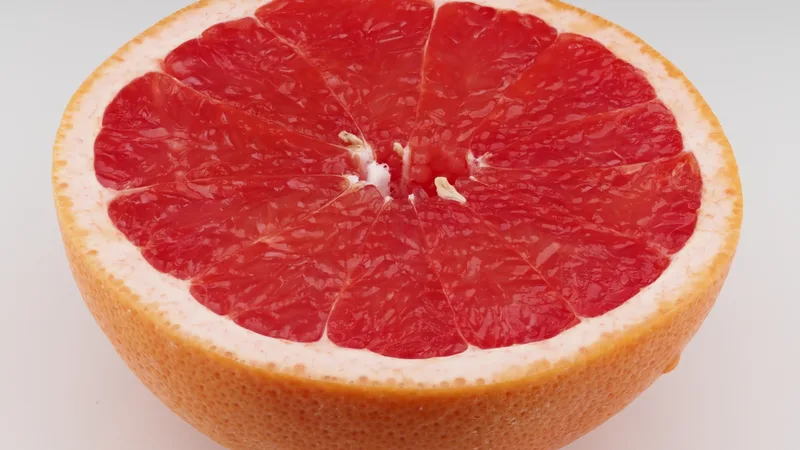 Photo: Jedesto / CC BY-SA 4.0, via Wikimedia Commons
Short answer: grapefruit contains furanocoumarins that irreversibly inhibit intestinal CYP3A4. CYP3A4-dependent statins undergo less first-pass metabolism, so plasma concentrations rise.
Oral statins face metabolism before they ever reach the systemic circulation, and that presystemic elimination sets the baseline exposure every dose builds on. CYP3A4, a cytochrome P450 enzyme expressed in the liver and the wall of the small intestine, metabolises approximately half of all drugs. A significant fraction of this metabolism occurs in the intestinal wall itself, which means the gut determines how much statin survives before the liver even sees it. This intestinal gatekeeping is the reason grapefruit, which acts in the gut wall, changes statin levels so dramatically.
Furanocoumarins in grapefruit cause mechanism-based inhibition of intestinal CYP3A4: the enzyme is inactivated and activity returns only when new enzyme is synthesised, which takes approximately 24 hours. Because the inhibition is irreversible, separating the tablet from the juice by a few hours changes nothing. Reduced presystemic metabolism therefore means a larger fraction of each dose reaches the systemic circulation. The dose is unchanged. The fraction absorbed intact increases. See the StatPearls review of CYP3A4 substrates and inhibitors for the substrate list.
Grapefruit inhibits intestinal CYP3A4. CYP3A4-dependent statins undergo less first-pass metabolism. Plasma concentrations rise.
Simvastatin and lovastatin are CYP3A4 substrates with high first-pass extraction, so the interaction is largest with these agents: a large fraction of each dose normally never survives the gut wall, and grapefruit removes that barrier. Atorvastatin is also a CYP3A4 substrate, though with lower extraction and therefore a smaller interaction. Pravastatin, rosuvastatin and pitavastatin are not significantly metabolised by CYP3A4, so grapefruit has minimal effect on their plasma concentrations. In exam stems pairing grapefruit with a statin, the expected answer is substitution with a non-CYP3A4 statin, which is why memorising this split matters more than memorising individual drug names.
The interaction scales with grapefruit quantity: a single glass produces measurable inhibition, while regular consumption maintains near-maximal suppression of intestinal CYP3A4. Because recovery requires de novo enzyme synthesis over approximately 24 hours, the effect persists into the next day even without further intake. This duration explains why timing strategies fail and why substitution, not scheduling, is the tested answer. Patients frequently propose taking the tablet in the morning and drinking the juice at night, which sounds reasonable and does not work, because the enzyme is still absent when the next dose arrives. Separating the two in time cannot help when the inhibition outlasts the dosing interval. The variability between grapefruit products compounds the problem, since furanocoumarin content differs between fresh fruit, juice concentrates and different cultivars, so no reliable quantity can be described as safe.
Confusable pairs like this are drilled daily inside the PharmBit app, one mechanism, one trap, five minutes.
Elevated statin plasma concentrations increase the risk of myopathy and, in severe cases, rhabdomyolysis (see the StatPearls review of statin myopathy for the exposure-response data). The interaction extends beyond statins to other CYP3A4 substrates with high first-pass extraction, including certain calcium-channel blockers, ciclosporin and some benzodiazepines. The common thread across every affected drug is high first-pass extraction by intestinal CYP3A4, which is why the list looks arbitrary until you notice what its members share. Immunosuppressants such as ciclosporin and tacrolimus matter most in practice because their therapeutic index is narrow, so a proportional rise in exposure that would be tolerable for a statin can cause nephrotoxicity instead. The size of the concentration change depends on the enzyme, but the seriousness of that change depends on the therapeutic index of the drug affected. For the other high-yield interaction class tested alongside CYP-mediated effects, see statin muscle pain: mechanism and counselling.
| Statin | Main metabolic route | Grapefruit effect | Exam position |
|---|---|---|---|
| Simvastatin | CYP3A4, high first-pass extraction | Large increase | Avoid the combination |
| Lovastatin | CYP3A4, high first-pass extraction | Large increase | Avoid the combination |
| Atorvastatin | CYP3A4, lower extraction | Moderate increase | Clinically relevant |
| Pravastatin | Not significantly CYP3A4 | Minimal | Common substitution |
| Rosuvastatin | Mainly CYP2C9, limited metabolism | Minimal | Common substitution |
| Pitavastatin | Largely glucuronidation | Minimal | Common substitution |
Metabolism is not the only thing standing between an oral statin and the systemic circulation, because transport proteins move these drugs across membranes as well. Hepatic uptake of several statins depends on the OATP1B1 transporter, which carries drug from portal blood into hepatocytes where it acts and is cleared. Reduced transporter function therefore leaves more statin in the circulation rather than in the liver, and muscle exposure rises accordingly. Metabolism and transport are separate gates on the same journey, so a question about raised statin levels is not always a CYP3A4 question. This matters because the resulting muscle toxicity looks identical whichever gate failed, and distinguishing them is what a well-written stem is testing. The muscle side of that story is covered in statin muscle pain.
The inhibition is caused by a specific group of grapefruit constituents rather than by acidity or vitamin C. The principal agents are bergamottin and 6’,7’-dihydroxybergamottin, with epoxybergamottin also implicated, and all act as mechanism-based inhibitors of CYP3A4 [3]. A mechanism-based inhibitor is metabolised by the enzyme into a reactive species that then inactivates that same enzyme, which is why the term suicide inhibitor is used. The enzyme destroys itself in the act of metabolising the furanocoumarin, so activity cannot return until new enzyme protein is synthesised. That is the molecular reason a single exposure produces an effect lasting into the following day, and it is what separates this interaction from ordinary competitive inhibition.
Grapefruit is consumed orally and its furanocoumarins are themselves extensively metabolised, so very little reaches the liver in active form. The consequence is that inhibition is concentrated in enterocytes of the small intestine, where the juice makes direct contact with the epithelium. Hepatic CYP3A4 is therefore largely spared, which produces a distinctive pattern. Grapefruit raises the fraction of an oral dose that is absorbed intact rather than slowing elimination, so it affects oral drugs with high first-pass extraction and has essentially no effect on the same drug given intravenously. That site-specific action is a favourite discriminator in questions, because it predicts which formulations are at risk.
Grapefruit is one entry in a much larger set of CYP3A4 interactions, and the FDA maintains a public table of substrates, inhibitors and inducers for exactly this reason [4]. Recognising the general pattern is more efficient than memorising individual pairs, because the same logic governs every CYP3A4 substrate with significant first-pass metabolism. The full mechanism, including why induction behaves so differently from inhibition, is set out in CYP450 inducers and inhibitors. Once you can classify a drug as a CYP3A4 substrate with high first-pass extraction, you have predicted its grapefruit interaction without needing to have seen the pair before.
Substitution works because the statin class is not uniform in its metabolism, which is unusual and clinically convenient. Moving a patient from simvastatin to pravastatin or rosuvastatin removes the CYP3A4 dependence entirely rather than merely reducing exposure, so the interaction disappears instead of being managed. Dose reduction is a weaker strategy because the degree of inhibition varies with the quantity and preparation of grapefruit consumed, which is not something a prescriber can control. Exams favour substitution because it eliminates the mechanism rather than negotiating with it. The broader properties that separate statins from one another are covered in our statin class guide.
Not all citrus fruit inhibits CYP3A4, and the split does not follow how sour the fruit tastes. Sweet orange juice contains negligible furanocoumarins, so it does not produce the interaction despite being citrus and acidic. Seville or bitter orange does contain them, which matters because it appears in marmalade and in some traditional preparations rather than as a drink. Pomelo inhibits the enzyme too, which is unsurprising given grapefruit is descended from it, and tangelo shares the same ancestry. Furanocoumarin content, not acidity or citrus classification, determines whether a fruit produces the interaction. Exam stems exploit this by offering sweet orange juice as a plausible distractor, and the reasoning that defeats it is compositional rather than intuitive.
Grapefruit plus simvastatin indicates substitution with pravastatin or rosuvastatin. The interaction persists for approximately 24 hours after ingestion because enzyme activity recovers only through de novo synthesis. Separating the dose from the juice by a few hours does not avoid the interaction.
Grapefruit furanocoumarins irreversibly inhibit intestinal CYP3A4, reducing first-pass metabolism so CYP3A4-dependent statins reach higher plasma concentrations. Simvastatin and lovastatin carry the largest interaction; pravastatin, rosuvastatin and pitavastatin escape it. The effect lasts approximately 24 hours because recovery requires new enzyme synthesis, which is why substitution beats scheduling in every exam stem.
1. A patient on simvastatin drinks grapefruit juice daily and reports new muscle aches. What is the mechanism?
2. Which statin is the appropriate substitution?
Grapefruit furanocoumarins irreversibly inhibit intestinal CYP3A4, so less of the statin is broken down before reaching blood. More drug survives first pass, levels rise.
Simvastatin, lovastatin and atorvastatin depend heavily on CYP3A4. Pravastatin, rosuvastatin and pitavastatin do not, so exams use them as the safe switch.
No. Sweet orange juice lacks meaningful furanocoumarins. Seville (bitter) orange and pomelo can, which is exactly the distractor exams plant.
The inhibition is mechanism-based and irreversible. The gut must make new CYP3A4 enzyme, which takes about 24 hours. Timing the tablet away from the juice does not fix it.
For study only. This post explains pharmacology concepts for exam preparation. It is not medical advice. Always follow your course materials, formulary, and supervisor guidance for clinical decisions.
The safety facts exams love, one at a time, before you need them.
Free to download. 7-day Pro trial. No credit card.
Myopathy mechanism, CYP interactions that raise risk, and counselling points. Safety-first pharmacology in six minutes.
Immunoassays detect a molecular shape, not a named drug. Which prescribed drugs cross-react, why, and the benzodiazepine trap that runs the other way.
Renal, gastric and bronchial risks explained by mechanism. The avoid list for pharmacy exams in six minutes.
Cumulative muscarinic blockade causing confusion, retention and falls. The older-adult safety topic in six minutes.