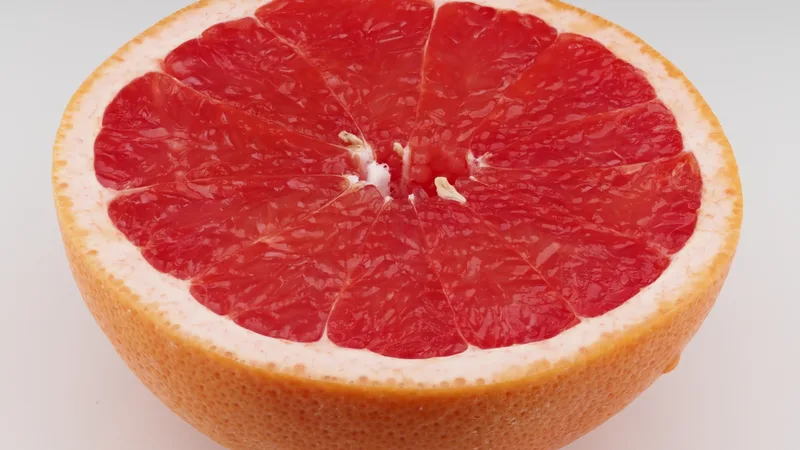
Why grapefruit blocks statins: CYP3A4 explained for pharmacy exams 2026
Intestinal CYP3A4 inhibition explained, which statins are affected, and the exam trap. Safety-first pharmacology in six minutes.
 Photo: Wikimedia Commons / CC BY-SA 3.0, via Wikimedia Commons
Short answer: statins inhibit HMG-CoA reductase in muscle as well as liver. Higher plasma concentrations increase muscle effects, so interacting drugs that raise statin levels raise myopathy risk.
HMG-CoA reductase exists in every cell that synthesises cholesterol, not only hepatocytes, so systemic statin exposure inhibits the enzyme in muscle too. Hepatic inhibition is therapeutic because the liver drives LDL clearance; muscle inhibition is collateral because muscle needs the same mevalonate pathway for cell function. This shared target explains why muscle effects scale with plasma concentration rather than appearing randomly.
HMG-CoA reductase inhibition reduces mevalonate synthesis and downstream isoprenoids required for muscle cell function. Mitochondrial dysfunction follows at higher exposures, impairing energy production in fibres with the highest metabolic demand. The spectrum runs from myalgia (pain without creatine kinase elevation) through myopathy (pain with elevation) to rhabdomyolysis (massive breakdown with myoglobin release and renal injury risk). The StatPearls review of statin pharmacology details the concentration-response relationship.
CYP3A4 inhibitors (clarithromycin, erythromycin, azole antifungals, grapefruit) raise plasma concentrations of CYP3A4-dependent statins by blocking their main clearance route. Gemfibrozil inhibits statin glucuronidation and OATP uptake in addition to CYP effects, attacking elimination on three fronts at once, which makes the combination highest risk. Ciclosporin inhibits OATP1B1 transport, trapping statin in plasma. For the CYP3A4 mechanism in full, see why grapefruit blocks statins.
Muscle risk follows statin plasma concentration. New interacting drug plus new muscle pain identifies the precipitant.
Patients report unexplained muscle pain, tenderness or weakness, particularly with dark urine, fever or malaise. Baseline liver function is assessed before initiation per local protocol. Grapefruit intake is reviewed at counselling.
Adverse-effect patterns like this are drilled daily inside the PharmBit app, one mechanism, one trap, five minutes.
Hypothyroidism, renal impairment, advanced age and high statin doses each independently raise myopathy risk. The StatPearls review of CYP3A4 substrates and inhibitors lists the interacting drugs that raise exposure. Exam stems stack two or more risk factors and ask for the precipitant or the next monitoring step.
All muscle pain on a statin requires immediate discontinuation. Mild myalgia prompts review of interacting drugs, dose, and alternative statins per protocol. Rhabdomyolysis with dark urine is the emergency presentation.
New macrolide plus statin plus muscle pain indicates interaction-driven myopathy. Dark urine plus severe pain indicates rhabdomyolysis with renal monitoring. Gemfibrozil plus statin is the highest-risk combination tested.
The description a patient gives carries diagnostic weight, and exams reward students who notice it. Statin-associated muscle symptoms are characteristically symmetrical and proximal, affecting the large muscle groups of the thighs, buttocks, shoulders and back rather than distal or one-sided areas. Onset typically follows within weeks of starting or of a dose increase, which is why the medication timeline matters as much as the symptom itself. Pain confined to one limb, or associated with swelling and redness, points away from a statin effect and toward another cause. Symmetrical proximal muscle discomfort that began after a statin was started or increased is the pattern worth recognising, and asymmetry argues against the drug. Dark urine alongside severe weakness changes the situation entirely, because it suggests myoglobinuria rather than simple aching and requires urgent assessment rather than reassurance.
Some patients start from a higher risk position before any interaction is considered, and recognising them is part of the same reasoning. Advanced age, small body frame, female sex, hypothyroidism, renal or hepatic impairment, and high levels of physical exertion all appear as risk factors, and several of them operate by raising drug exposure or reducing muscle reserve. Untreated hypothyroidism is particularly worth knowing because it independently causes myopathy and raises creatine kinase, so it can both mimic and compound a statin effect. Checking thyroid function in a patient with statin muscle symptoms is testing whether an alternative cause is doing the work, not being thorough for its own sake. Vitamin D deficiency is often cited in the same context, though the evidence connecting it to statin intolerance is weaker than the frequency of its mention suggests.
Statin muscle effects are not one condition but a graded spectrum, and treating them as a single entity is what makes questions on this topic confusing. Myalgia describes muscle pain or weakness with a normal creatine kinase, and it is by far the most common presentation. Myopathy adds a rise in creatine kinase, indicating that muscle fibres are actually being damaged rather than simply hurting. Rhabdomyolysis sits at the extreme, with marked creatine kinase elevation, myoglobin release and the risk of acute kidney injury as myoglobin obstructs and injures renal tubules. The three terms describe increasing degrees of muscle fibre breakdown, so the laboratory value is what separates them rather than the severity of the patient's complaint. A rare immune-mediated necrotising myopathy also exists, which differs importantly in that it persists after the statin is stopped rather than resolving.
The mechanism follows from where the blocked pathway leads. HMG-CoA reductase sits at the start of the mevalonate pathway, and that pathway produces more than cholesterol. Downstream products include coenzyme Q10, which participates in mitochondrial electron transport, and isoprenoids required for prenylation of regulatory proteins. Skeletal muscle has high energy demand and dense mitochondrial content, so it is disproportionately sensitive to any reduction in mitochondrial function. Blocking the pathway lowers cholesterol as intended and also reduces other mevalonate products, which is why the tissue with the greatest mitochondrial dependence is the one that complains. That reasoning also explains why the effect is concentration dependent rather than idiosyncratic.
Because the mechanism is dose related, anything that raises statin concentration raises muscle risk in proportion. Higher prescribed doses do this directly. CYP3A4 inhibitors do it indirectly by reducing clearance of simvastatin, lovastatin and atorvastatin, and the list of such inhibitors is long enough that interaction checking matters more here than in most classes [3]. Reduced hepatic uptake through the OATP1B1 transporter does it a third way, by leaving drug in the circulation instead of delivering it to the liver. Three separate mechanisms all converge on the same outcome of higher systemic statin exposure, which is why the risk factors look unrelated until you trace them. The grapefruit version of this interaction is worked through in why grapefruit blocks statins.
Statins differ in metabolic route, and that difference is the basis of most management decisions. Simvastatin and lovastatin are CYP3A4 substrates with high first-pass extraction, so they are the most vulnerable to interaction. Atorvastatin is also a CYP3A4 substrate but less heavily extracted. Pravastatin, rosuvastatin and pitavastatin avoid CYP3A4 largely or entirely, which is why they appear as substitutions when an interacting drug cannot be stopped. Switching within the class can remove an interaction completely, which is unusual and is why substitution rather than dose reduction is so often the expected answer. The broader properties separating these agents are set out in our statin class guide.
Statin muscle symptoms are unusual in that reported rates differ sharply between observational practice and blinded trials. In blinded randomised conditions, muscle symptom rates on statin and on placebo are far closer than the rates reported when patients and clinicians know what is being taken. That gap is attributed to the nocebo effect, where expectation of a known side effect contributes to experiencing it. Acknowledging the nocebo contribution does not mean the symptoms are imagined, and it does not apply to myopathy with raised creatine kinase, which is objectively measurable. It matters clinically because it supports structured rechallenge rather than permanent abandonment of a drug class with strong outcome evidence. The practical consequence is that how a statin is introduced influences how it is tolerated, since a patient warned in alarming terms about muscle pain is more likely to notice and attribute ordinary aches to the drug. Honest counselling that names the symptom to report, without dwelling on it, tends to produce better tolerance than either silence or emphasis. This is one of the few places where the framing of the explanation is itself part of the intervention.
Myalgia does not end statin therapy permanently in most cases, because cardiovascular protection outweighs transient muscle symptoms. Rechallenge follows a sequence: exclude interacting drugs and hypothyroidism, switch to a hydrophilic or non-CYP3A4 statin such as pravastatin or rosuvastatin, reduce dose, then consider alternate-day dosing per local protocol. Each step lowers exposure while preserving LDL reduction. Exam stems that ask for the next step after myalgia resolution test this sequence, not discontinuation.
Muscle shares the liver HMG-CoA reductase target, so myopathy risk follows plasma concentration. Interacting drugs that block CYP3A4, glucuronidation or OATP transport raise exposure and precipitate symptoms. Mild myalgia prompts review and switch; rhabdomyolysis with dark urine is the emergency.
1. A patient on simvastatin starts clarithromycin and develops muscle pain. What is the mechanism?
2. The pain is severe with dark urine. What does this indicate?
HMG-CoA reductase inhibition in muscle tissue disrupts downstream isoprenoid synthesis and mitochondrial function. Higher plasma concentrations increase the effect, which is why interacting drugs raise myopathy risk.
CYP3A4 inhibitors (macrolides, azoles, grapefruit), fibrates (especially gemfibrozil), and ciclosporin. Each raises statin plasma concentrations through reduced metabolism or transport inhibition.
Dark urine with severe muscle pain and weakness indicates rhabdomyolysis with myoglobin release. This requires immediate assessment for renal injury.
Exam stems distinguish mild myalgia from rhabdomyolysis. Mild symptoms prompt review of interacting drugs and possible statin switch; rhabdomyolysis prompts immediate action. Follow local protocol, not this post, for decisions.
For study only. This post explains pharmacology concepts for exam preparation. It is not medical advice. Always follow your course materials, formulary, and supervisor guidance for clinical decisions.
The safety facts exams love, one at a time, before you need them.
Free to download. 7-day Pro trial. No credit card.
Intestinal CYP3A4 inhibition explained, which statins are affected, and the exam trap. Safety-first pharmacology in six minutes.
INR target range, vitamin K consistency, key interactions and bleeding signs. Safety-first pharmacology in six minutes.

Na/K ATPase mechanism, hypokalaemia potentiation, arrhythmia patterns and digoxin immune fab antidote.
Narrow therapeutic index, sodium-dehydration handling, NSAID interaction and toxicity signs.