
What does -dipine mean?
The -dipine stem marks a dihydropyridine calcium channel blocker acting on vessels rather than the heart. Why that causes ankle oedema and reflex tachycardia.
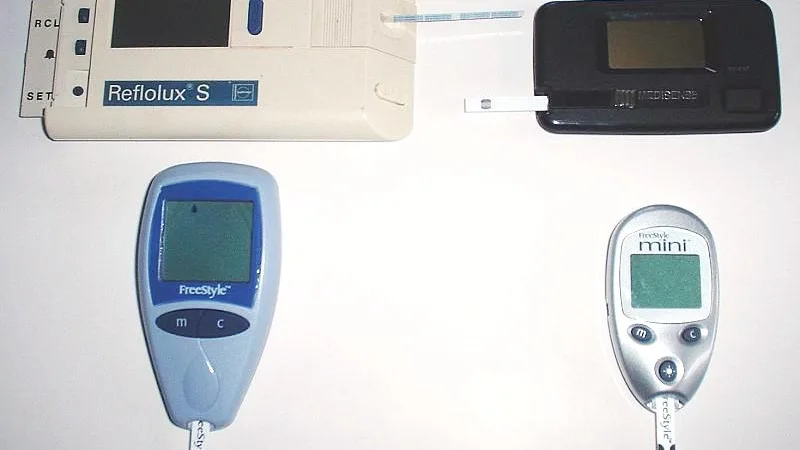 Photo: Christer Johansson / Public domain, via Wikimedia Commons
Short answer: falling glucose triggers adrenaline release, and adrenaline causes tremor and palpitations. Beta-blockers antagonise beta receptors, so these warning signs are blunted.
Hypoglycaemia threatens the brain, which depends almost entirely on glucose, so the body evolved an early alarm that fires before cognitive function fails. That alarm is the sympathoadrenal response: adrenaline is released and acts on beta receptors to produce tremor, palpitations and anxiety. These adrenergic symptoms function as early warning signs, prompting carbohydrate intake before neuroglycopenia develops. The entire masking phenomenon follows from silencing this alarm while the underlying glucose fall continues.
Beta-blockers competitively antagonise beta-adrenergic receptors, which removes exactly the receptors the alarm depends on. Tremor (beta-2 mediated) and palpitations (beta-1 mediated) are attenuated in proportion to blockade. The glucose fall continues, but the adrenergic alarm does not sound, so the patient loses the interval between warning and cognitive failure. Sweating persists because sweat glands use muscarinic receptors outside the blockade. Confusion and drowsiness persist because they result directly from cerebral glucose deprivation, as described in the StatPearls review of beta-blocker pharmacology.
Beta-blockers blunt tremor and palpitations. Sweating and confusion remain. Absent tremor does not mean normal glucose.
Patients on insulin or sulfonylureas depend on adrenergic symptoms to detect hypoglycaemia. Masked symptoms delay recognition and increase progression to severe neuroglycopenia. Metformin monotherapy rarely causes hypoglycaemia, so masking is less relevant there. See statin muscle pain: mechanism and counselling for another concentration-dependent adverse effect.
Adverse-effect mechanisms like this are drilled daily inside the PharmBit app, one mechanism, one trap, five minutes.
Cardioselective (beta-1 selective) agents attenuate cardiac symptoms less at usual doses, because palpitations are beta-1 mediated and tremor is beta-2 mediated, so selectivity spares one alarm partially. But masking still occurs and selectivity is lost at higher doses, consistent with the dose-dependent selectivity described for metoprolol. For the ACE inhibitor comparison that follows the same X-vs-Y exam pattern, see ACE inhibitors vs ARBs.
Masked patients cannot rely on symptoms, so monitoring shifts from reactive to scheduled. Capillary glucose checks move to fixed intervals around meals, exercise and bedtime rather than symptom-triggered testing. Continuous glucose monitoring with hypoglycaemia alarms replaces the lost adrenergic alarm with an electronic one. Exam stems that mention increased monitoring frequency in a beta-blocked diabetic test this substitution principle, not any change to the beta-blocker itself.
Beta-blockers lower blood sugar. They do not. They impair recognition of low blood sugar by blunting the adrenergic response. Glucose itself is unaffected by the blockade.
Given the risk, the obvious question is why the combination occurs at all, and the answer is that the benefit is frequently larger than the hazard. Patients with diabetes have elevated cardiovascular risk, so they are precisely the group most likely to need a beta-blocker after myocardial infarction or for heart failure, where the mortality benefit is substantial and well established. Withholding a drug with proven outcome benefit to avoid an adverse effect that can be managed by monitoring is a poor trade. Masking is a reason to change monitoring and agent selection, not a reason to withhold a treatment that reduces mortality. This is why exam stems reward candidates who choose a cardioselective agent and increase glucose monitoring rather than those who simply refuse the class, and it is a recurring pattern in questions about diabetes comorbidity generally.
Beta blockade is not the only route to losing warning symptoms, and distinguishing the causes matters. Repeated episodes of hypoglycaemia themselves blunt the counter-regulatory response, a phenomenon called hypoglycaemia-associated autonomic failure, in which each episode lowers the glucose threshold at which adrenaline is released. A patient who has had frequent lows therefore experiences symptoms later and at a lower glucose concentration than someone who has not. Drug-induced masking and hypoglycaemia-induced impaired awareness produce the same clinical picture through entirely different mechanisms, and a patient can have both at once. The distinction matters because impaired awareness can be partly reversed by scrupulously avoiding hypoglycaemia for a period, whereas masking resolves only when the drug is changed.
Adrenaline is one part of a layered defence, and seeing the whole sequence explains why beta blockade matters where it does. As glucose falls, insulin secretion is suppressed first, which is the earliest and most sensitive response. Glucagon is released next and drives hepatic glycogenolysis and gluconeogenesis, and it is the principal hormone restoring glucose. Adrenaline follows, reinforcing hepatic glucose output and producing the symptoms that warn the patient. Cortisol and growth hormone act later and matter mainly in prolonged hypoglycaemia [3]. Beta blockade interferes with the adrenaline layer only, which is why it removes warning symptoms rather than abolishing glucose recovery outright. In patients with longstanding type 1 diabetes the glucagon response is often already impaired, so removing the adrenergic layer as well leaves very little defence. That combination explains why the same beta-blocker carries different risk in type 1 and type 2 diabetes, and why duration of disease is worth asking about rather than diagnosis alone.
| Symptom | Mediated by | On a beta-blocker | Consequence |
|---|---|---|---|
| Tremor | Adrenergic, beta-2 | Blunted | Lost as a warning sign |
| Palpitations | Adrenergic, beta-1 | Blunted | Lost as a warning sign |
| Anxiety | Adrenergic | Blunted | Lost as a warning sign |
| Sweating | Cholinergic, muscarinic | Preserved | The remaining discriminator |
| Hunger | Mixed, partly cholinergic | Largely preserved | Unreliable alone |
| Confusion, drowsiness | Neuroglycopenic | Preserved | Appears late, after warning is lost |
| Seizure, coma | Neuroglycopenic | Preserved | End of the spectrum |
Reading down the third column shows the clinical problem precisely. Everything that warns early is blunted, and everything preserved either appears late or cannot be interpreted on its own. The patient loses the early warnings and keeps the late ones, which compresses the interval between noticing and being unable to act. Sweating alone is a weak signal in practice, because it is non-specific and easily attributed to heat, exertion or anxiety, so relying on it is not equivalent to having the full warning set.
Masking is the effect students remember, but nonselective agents add a separate and arguably more dangerous problem. Beta-2 receptors in liver and skeletal muscle mediate glycogenolysis, so blocking them impairs the mobilisation of stored glucose. Recovery from a hypoglycaemic episode therefore takes longer, and the episode is deeper as well as less apparent. A nonselective beta-blocker both hides the fall and slows the recovery, which is why the two problems compound rather than simply coexist. Cardioselective agents spare beta-2 receptors substantially at usual doses, so they interfere less with recovery, and that is a further reason selectivity is preferred here. The dose dependence of that sparing is covered in selective vs nonselective beta-blockers.
Sweating is the one warning that survives, and the reason is anatomical rather than incidental. Sweat glands receive sympathetic innervation, which would suggest adrenergic control, but their postganglionic fibres are the exception in the sympathetic system and release acetylcholine onto muscarinic receptors [4]. Beta blockade therefore has no effect on them. Sweating is a sympathetic function operating through a cholinergic synapse, which is exactly why it escapes a drug that blocks beta receptors. That anatomical quirk is what makes diaphoresis the single most useful remaining sign, and the wider map it belongs to is set out in how to memorize autonomic pharmacology.
The interaction only matters where hypoglycaemia is possible in the first place, which narrows the group considerably. Patients on insulin or sulfonylureas are at genuine risk because both can lower glucose below normal independently of intake. Metformin, DPP-4 inhibitors and SGLT2 inhibitors rarely cause hypoglycaemia as monotherapy, so masking is far less relevant for them. Additional risk factors include impaired awareness from previous episodes, renal impairment prolonging drug action, irregular meals, alcohol and exercise. Masking is a problem of the glucose-lowering drug the patient takes, not of diabetes itself, which is why the medication list decides the answer. Sulfonylureas deserve particular attention because they stimulate insulin release regardless of the prevailing glucose concentration, so hypoglycaemia can occur when a meal is missed. Longer-acting agents in that class prolong the risk window considerably, and renal impairment extends it further by slowing clearance. A patient on a long-acting sulfonylurea, a nonselective beta-blocker and with declining renal function combines every factor in this post at once, which is why that combination appears so often in written questions.
Diabetic on a beta-blocker without tremor during hypoglycaemia indicates masking, not euglycaemia. Sweating as the remaining symptom is the classic discriminator. The expected management principle tested is increased glucose monitoring, not beta-blocker dose adjustment.
Falling glucose triggers adrenaline-mediated tremor and palpitations that warn before cognitive failure. Beta-blockers antagonise the receptors behind both signs, silencing the alarm while glucose keeps falling. Sweating and confusion persist through muscarinic and neuroglycopenic pathways. Scheduled monitoring replaces symptom reliance in masked patients.
1. A diabetic patient on propranolol develops hypoglycaemia without tremor or palpitations but with sweating. What explains this pattern?
2. Which symptom of hypoglycaemia is unaffected by beta-blockers?
Hypoglycaemia triggers adrenaline release, causing tremor, palpitations and sweating. Beta-blockers antagonise beta receptors, so tremor and palpitations are blunted. The warning signs do not appear.
Sweating persists because it is mediated by muscarinic receptors, not beta receptors. Neuroglycopenic symptoms (confusion, drowsiness) also persist because they result from glucose lack, not adrenaline.
Patients on insulin or sulfonylureas rely on warning symptoms to detect falling glucose. Masked symptoms delay recognition, increasing risk of severe neuroglycopenia.
Partially. Beta-1 selective agents blunt cardiac symptoms less at usual doses, but masking still occurs. Exams treat all beta-blockers as capable of masking.
For study only. This post explains pharmacology concepts for exam preparation. It is not medical advice. Always follow your course materials, formulary, and supervisor guidance for clinical decisions.
Understanding why beats memorizing what. One mechanism explained properly, every day.
Free to download. 7-day Pro trial. No credit card.
The -dipine stem marks a dihydropyridine calcium channel blocker acting on vessels rather than the heart. Why that causes ankle oedema and reflex tachycardia.
Mu-receptor gut mechanism, why tolerance does not develop, and PAMORA antagonists.
The -prazole stem marks a proton pump inhibitor. Why irreversible binding makes the effect outlast the drug, why dosing is before food, and the CYP2C19 trap.
The -azepam and -azolam stems mark benzodiazepines. Why frequency rather than duration of channel opening makes them safer than barbiturates, and which are safe in liver disease.