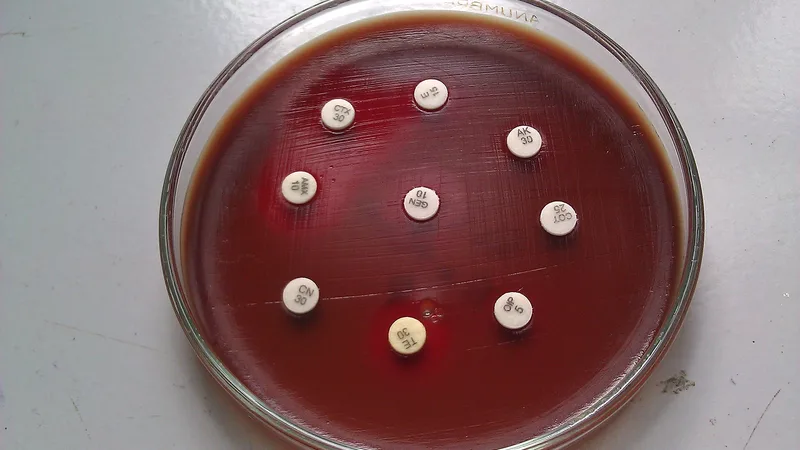
Mycin vs micin: one letter, two organisms
The endings mark the organism that produced the antibiotic, not how it works. Why gentamicin and erythromycin are spelled differently and share nothing else.
 Photo: Gray’s Anatomy plate / Public domain, via Wikimedia Commons
Short answer: serotonin syndrome is serotonergic excess with clonus and hyperreflexia developing within hours. NMS is dopamine blockade with lead-pipe rigidity developing over days. Clonus splits them.
Both syndromes present with hyperthermia, autonomic instability, altered mental status and elevated creatine kinase. Both are drug-induced emergencies. Exam stems exploit this overlap by listing shared features first and burying the discriminator in the neurological examination. The shared features establish emergency status. They do not establish the diagnosis.
Excessive serotonergic activity at central 5-HT receptors, usually 5-HT2A, produces the triad of mental status changes, autonomic hyperactivity and neuromuscular excitation. The neuromuscular excitation takes the form of hyperreflexia and clonus: rhythmic involuntary muscle contractions in response to stretch. Ocular clonus (sustained lateral eye movements) is highly specific. Precipitants are serotonergic combinations rather than single agents in most cases: SSRI plus MAOI, SSRI plus tramadol, SSRI plus linezolid, SSRI plus dextromethorphan. The StatPearls review of serotonin syndrome details the Hunter diagnostic criteria.
Clonus means serotonin syndrome. Lead-pipe rigidity without clonus means NMS. Hours means serotonin; days means NMS.
Dopamine receptor blockade in the nigrostriatal pathway and hypothalamus produces severe muscle rigidity (described as lead-pipe because resistance is uniform throughout movement), hyperthermia from impaired thermoregulation, autonomic instability and altered consciousness. Bradykinesia and bradyphrenia accompany the rigidity. Precipitants are dopamine antagonists: haloperidol and other first-generation antipsychotics, antiemetics such as metoclopramide, and abrupt withdrawal of levodopa in Parkinson disease. The StatPearls review of NMS covers the DSM-5 diagnostic criteria.
Syndrome pairs like this are drilled daily inside the PharmBit app, one mechanism, one trap, five minutes.
Onset: hours (serotonin) versus days (NMS). Neuromuscular: clonus and hyperreflexia versus lead-pipe rigidity and bradykinesia. Bowel sounds: hyperactive versus normal. Precipitants: serotonergic combinations versus dopamine antagonists. Treatment: cyproheptadine plus benzodiazepines versus dantrolene or bromocriptine plus supportive care. Every row is independently examinable.
The Hunter Serotonin Toxicity Criteria diagnose serotonin syndrome when a serotonergic agent plus one of the following is present: spontaneous clonus, inducible clonus with agitation or diaphoresis, ocular clonus with agitation or diaphoresis, tremor with hyperreflexia, or hypertonia with fever above 38 degrees plus ocular or inducible clonus. The criteria prioritise clonus findings over vital-sign abnormalities, which is why exam stems always include the neurological examination. Absence of clonus in a febrile rigid patient points away from serotonin syndrome regardless of the drug list.
Both syndromes elevate creatine kinase from sustained muscle activity, with higher values typical in NMS due to prolonged rigidity. Leukocytosis, metabolic acidosis and acute kidney injury from rhabdomyolysis complicate both. Low serum iron is reported in NMS but lacks diagnostic specificity. Laboratory findings confirm severity and complications; they do not establish the diagnosis, which remains clinical and centred on the neuromuscular examination plus the precipitant history.
Both syndromes require immediate discontinuation of the precipitant and supportive care with temperature control and hydration. Rhabdomyolysis complicates both through sustained muscle activity. For the concentration-dependent toxicity pattern that follows similar emergency logic, see digoxin toxicity signs.
Hyperthermia plus rigidity equals NMS by default. It does not. Serotonin syndrome also produces rigidity, but clonus coexists with it. The discriminator is clonus present versus clonus absent, not rigidity present versus absent.
SSRI plus tramadol plus clonus within hours indicates serotonin syndrome. Haloperidol plus lead-pipe rigidity over days indicates NMS. Treatment options are never interchangeable between the two.
The overlap is genuine rather than an artefact of poor teaching, and understanding why prevents the panic that leads to guessing. Both syndromes produce hyperthermia, altered mental status and autonomic instability, because both ultimately drive excessive muscular activity and disordered central thermoregulation. Heat generated by sustained muscle contraction exceeds the body's capacity to lose it, so temperature rises in both. Sustained muscle activity also releases creatine kinase in both, so that laboratory finding does not separate them either. The shared features come from a shared final pathway of muscle overactivity and heat generation, which is why the discriminators have to come from cause, motor pattern and tempo instead. Malignant hyperthermia belongs to the same differential and is distinguished by its trigger, since it follows exposure to volatile anaesthetics or suxamethonium rather than to psychiatric medication.
Because the underlying pharmacology is opposite, giving the wrong specific treatment is not merely ineffective but potentially harmful. Serotonin syndrome is managed by stopping the serotonergic agents and providing supportive care, with cyproheptadine as a serotonin antagonist where specific treatment is used. Neuroleptic malignant syndrome is managed by stopping the dopamine antagonist and providing supportive care, with dantrolene acting on muscle and bromocriptine restoring dopaminergic activity where specific treatment is used. A dopamine agonist given for serotonin syndrome, or a serotonin antagonist given for neuroleptic malignant syndrome, treats the wrong neurotransmitter entirely. Antipsychotics deserve particular caution, because giving one to sedate an agitated patient who actually has neuroleptic malignant syndrome worsens the very blockade causing it. Supportive care, cooling and withdrawal of the offending agent are what both syndromes share, and those steps come first in either case. The receptor logic behind these opposing actions is set out in how to memorize autonomic pharmacology.
The drug history is the strongest single discriminator, because the two syndromes are precipitated by opposite pharmacology. Serotonin syndrome is precipitated only by agents that increase serotonergic activity, which includes selective serotonin reuptake inhibitors, serotonin and noradrenaline reuptake inhibitors, monoamine oxidase inhibitors, tramadol, linezolid, triptans, lithium and St John's wort [3]. Neuroleptic malignant syndrome is precipitated by dopamine receptor antagonists, principally antipsychotics, and also by abrupt withdrawal of dopaminergic medication in Parkinson disease [4]. One syndrome comes from adding serotonin and the other from removing dopamine, so the medication list usually answers the question before the examination findings do. Risk is highest when two serotonergic drugs with different mechanisms are combined, which is why an antidepressant plus tramadol is the classic stem. Monoamine oxidase inhibitors carry the highest risk of any combination, and the washout required after stopping one before starting another serotonergic agent is measured in weeks rather than days. Fluoxetine complicates the same calculation, because its active metabolite has an unusually long half life, so serotonergic activity persists well beyond the last dose. A patient who stopped an antidepressant recently is not necessarily free of serotonergic activity, which is why a well-written stem always gives you the stop date.
The muscular findings are the most reliable physical discriminator, and they differ because the pathways involved differ. Serotonin syndrome produces hyperreactivity of the neuromuscular system, so the signs are clonus, hyperreflexia and tremor, and they are typically more marked in the lower limbs. Neuroleptic malignant syndrome produces generalised lead-pipe rigidity with bradyreflexia, meaning reflexes are reduced rather than exaggerated. Clonus and hyperreflexia point to serotonin excess, while rigidity with reduced reflexes points to dopamine blockade. This contrast is the single highest-yield fact on the topic, because it separates the two syndromes at the bedside without waiting for any laboratory result. Ocular clonus, elicited by observing sustained eye movements, is particularly useful because it is quick to test and rarely present in the alternative diagnoses.
Time course separates the two almost as reliably as the motor signs. Serotonin syndrome develops rapidly, usually within hours of the precipitating dose or drug addition, because it reflects an acute excess of a neurotransmitter already present. Neuroleptic malignant syndrome evolves over days to weeks, since it depends on progressive dopamine receptor blockade and downstream thermoregulatory and muscular consequences. Hours points to serotonin syndrome and days to weeks points to neuroleptic malignant syndrome, which is why stems always state the interval. Resolution follows the same asymmetry, with serotonin syndrome typically settling within a day or two of withdrawal while neuroleptic malignant syndrome takes considerably longer, and longer still with depot antipsychotics that cannot simply be stopped.
Serotonin syndrome and neuroleptic malignant syndrome both present with fever, altered mental state, autonomic instability and a muscular abnormality, which is why they are confused. They separate on cause, because one follows excess serotonergic activity and the other follows dopamine receptor blockade or dopaminergic withdrawal. They separate on motor findings, since clonus and hyperreflexia indicate the first while lead-pipe rigidity with reduced reflexes indicates the second. They separate on tempo, with hours against days to weeks. Because the underlying pharmacology is opposite, the specific treatments are not interchangeable, and identifying which syndrome is present determines what is safe to give.
1. A patient on sertraline starts tramadol and within 6 hours develops agitation, hyperthermia and inducible ankle clonus. What is the diagnosis?
2. A patient on haloperidol develops lead-pipe rigidity, fever and confusion over 3 days with no clonus. What is indicated?
3. Which finding best distinguishes the two syndromes?
Clonus. Inducible or spontaneous clonus indicates serotonin syndrome. Lead-pipe rigidity without clonus indicates NMS. Exams plant one of the two findings and expect the split.
Serotonergic combinations: SSRI plus MAOI, SSRI plus tramadol, SSRI plus linezolid, SSRI plus St John’s wort. Single agents rarely suffice except in overdose or MAOI combinations.
Dopamine antagonists: first-generation antipsychotics such as haloperidol, and antiemetics such as metoclopramide and prochlorperazine. Abrupt levodopa withdrawal can also precipitate it.
Serotonin syndrome develops within hours of the precipitant change. NMS develops over days. Onset speed is the second discriminator after the neuromuscular findings.
Serotonin syndrome: stop serotonergic agents, benzodiazepines for agitation, cyproheptadine in moderate-severe cases. NMS: stop the dopamine antagonist, dantrolene or bromocriptine per protocol, supportive care. Do not swap the treatments.
For study only. This post explains pharmacology concepts for exam preparation. It is not medical advice. Always follow your course materials, formulary, and supervisor guidance for clinical decisions.
Now spot the next one before the exam does. Confusable pairs, drilled daily.
Free to download. 7-day Pro trial. No credit card.
The endings mark the organism that produced the antibiotic, not how it works. Why gentamicin and erythromycin are spelled differently and share nothing else.
A laboratory definition, not a clinical one. What the MBC/MIC ratio means, why it shifts between labs, and what trials in severe infection actually found.

Which receptors each class blocks, why selectivity fades as the dose rises, and the asthma trap. Mechanism-first in seven minutes.
Codeine is a prodrug activated by CYP2D6, morphine is not. Poor and ultra-rapid metabolisers, and the exam trap.